Welcome to St. Michael’s. You may wonder if our worship is “cutting edge” – I would answer that we need to talk about which edge we want to be sharp. We believe that the quality of Christian worship is not defined by our feelings about the experience, but by what God has done, and still does, regardless of what we experience, and whether we show up or not.
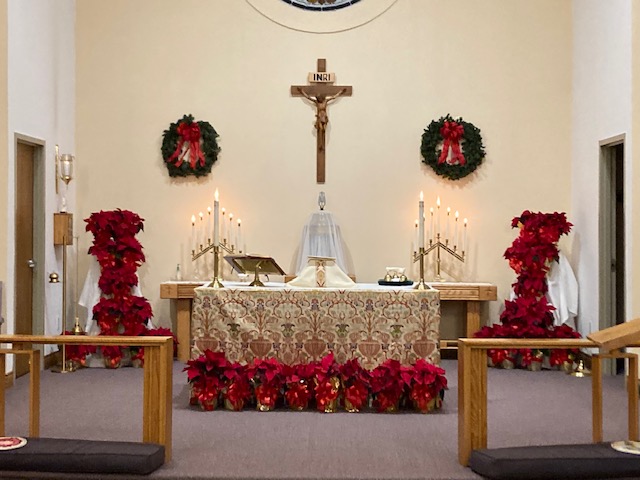
St. Michael’s worship could be called traditional worship because we follow the ancient liturgies of the Church – orders of service that evolved from first- and second-generation Christians modifying historical Jewish worship according to revelations about Jesus given by the Holy Spirit.
But it IS cutting edge, because our experience and application of eternal truth, mercy, and grace always takes place right now, in the present. We might say “what’s old is what’s new.”
More importantly, our Christian liturgy is not anything we Christians have invented – not even two thousand years ago. Our “service” is literally the service of God on behalf of humankind, and the service of humans to one another on behalf of God, for centuries, right now, and into the future.
Christ is in our midst and the Holy Spirit is at work among us. Because our relationship with God is always fresh and alive, our liturgy is merely the latest living expression of God working through us as a community. When God encounters us spiritually, it is an encounter that is also experienced physically, because human beings experience spiritual reality through their physical senses, in addition to mental and emotional perception. What is most important is not what we experience, but what our worship together does for others who are struggling in this world – for those who need God. Still, we who worship are also affected. Thank God for that.
“This is none other than the house of God, and this is the gate of heaven”
Genesis 28:17
“Liturgy” is a word we inherit from the Apostle Paul as he attempted to describe to members of the first churches how our worship as followers of Jesus is part and parcel of the One, True Worship, accomplished by Jesus Christ, once and for all on behalf of the whole human race. The Liturgy is Worship that Jesus Christ does, and has always done, in order to preserve the Created Order and to keep it in union with the Creator; to undo the division between Creator and Created that was introduced by Sin, and to reconcile all things to the Father once again, and forever.
Some things we do in the Liturgy may be confusing to people today. We understand that. One of the biggest issues is that God transcends time. What God does in the human timeline, at any point in history, still applies at any and all points in that timeline. It’s not easy to understand – but the Good News is that we get to experience Jesus making a difference in our lives right now, even though he may have done the heavy lifting two thousand years ago. What is done by God – no matter when – is done forever.
An important thing to remember is that we Christians are members of Christ’s Body. As hard as it is to make sense of things the way we are used to thinking, it means that what Jesus Christ does, and has done, is also done by US, as members of that Body that has done those things.
In short, the work that God does to save the Created Order is something that we participate in, by virtue of us being members of the Person who performs that Work. We are not Jesus, of course, but we cooperate and participate in his work for the world, as members of him.
“Christ our Passover is sacrificed for us – therefore let us keep The Feast.”
We do not repeat any past events – including sacrifices. Christ our Passover is and was sacrificed for us – for all of us – once and for all. This event cannot be repeated. Jesus Christ has included in himself the fulfillment of the Passover event – not only for the people of Israel, but for all humanity, including us Gentiles. But something we often forget is that this kind of event is history-making and history-shaking. What God does, and has done, can now be applied everywhere, at every time, forever and to eternity. The very same reason we can be saved today is the reason we can be a part of God saving and serving us and everyone today and forever. When we break the bread and say “Christ, our Passover is sacrificed for us,” we are not declaring that we are performing a new sacrifice – rather we are proclaiming that we are recognizing and participating in the one, once-for-all sacrifice that Christ performed for the human race by dying and rising. Our celebration of his sacrifice defines us as people who follow him, and our baptisms into Christ, and our offerings become OUR sacrifice that participate in his one sacrifice; hence we add baptismal water to the chalice.
“Stand up, sit down, fight, fight, fight!”
No, Sunday morning worship is not a football or basketball game, but in a traditional liturgy there are a lot of opportunities to stretch your legs, and to use other muscles. Churches had no pews until the Renaissance (that’s over a thousand years), and even then, there was only one or two pews used for Royalty or wealthy members of a parish. Mobility was the name of the game. People brought their own mats and rugs to kneel or sit on during the service, when needed. Most of the service was celebrated standing. The normal posture of prayer is standing, not kneeling, because standing upright is the posture of resurrection.
Still, you have to expect that, over the course of twenty centuries some different traditions must have developed – and they have. Too many to discuss here, actually. The most helpful thing for newcomers is to ask other people around them in the pews for a little guidance in using the Book of Common Prayer and the Hymnal.
“Wait – we have to read?”
Afraid so. At least at first. The Episcopal Church in the United States is the historical branch of the Anglican Church (or Church of England), as it was established in North America after the American Revolution. It has only been since 2003 that other “brands” of Anglicanism have invaded our country. That’s another story.
Reading prayers does not mean that prayer is less personal, or that you don’t mean the prayer you are praying. Sometimes we think our words need to be spontaneous to be meaningful, but we forget that nothing is spontaneous with the Holy Spirit. God knows what we will think and say before we speak. The key for us is to own the words we pray as if they are our own words – our own thoughts and prayers. They are! Many common prayers are easily memorized, and then books are no longer needed.
“What is the structure of a normal liturgy?”
Good question. Sunday morning worship is typically “Eucharistic.” This means we celebrate eucharist – which means “thanksgiving,” or giving thanks. We are not talking about the holiday we call “Thanksgiving.” We are talking about the fact that we are called to give thanks to God for what God has done for us, and to do that all the time. Jesus exhorted us to give thanks in the way he demonstrated at the Last Supper, every time we get together as a body of believers.
A normal eucharistic liturgy (Sunday service) has two major portions. The first is called “The Service of the Word,” and the second is called different things, like “The Service of the Table,” or “Eucharist,” or “Communion.” Communion is actually what we are, unified with one another and with God in Jesus Christ by what he has done for us. Eucharist is the larger prayer of thanksgiving that prepares us to celebrate our communion. It is important that this happens in the context of a symbolic meal because sitting down at the same table across from God indicates that we are at peace with him, and that there are no problems to separate us any longer.
In short, our worship services (our liturgies) gather us to be the Body of Christ, and then walk us through a process that reminds us of who we really are in God, that reorients us, challenges us, and empowers us to be ministers and extensions of Jesus in the world. Then the liturgy sends us out to have an impact on the world because we have been transformed and continue in the process of being transformed into likeness with Christ.
 St. Michael's Episcopal Church